
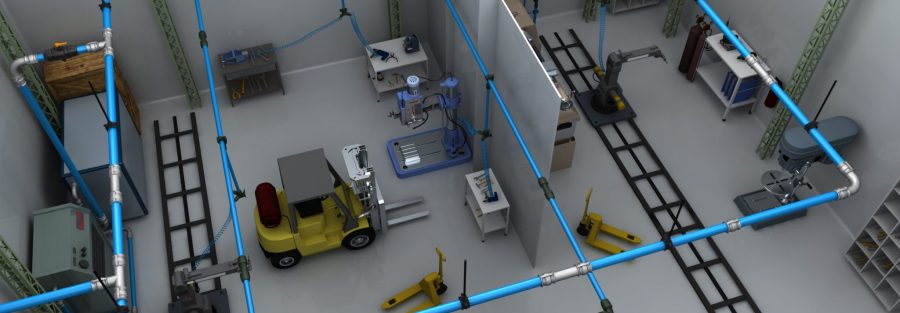
Most industrial facilities rely heavily on compressed air systems to power the tools, machinery, and automation utilized in production. Compressed air pipe, which distributes the air to the end points, is just as crucial to the compressed air system as air compressors, which are the center of focus for most compressed air systems.
In order to guarantee the greatest levels of efficiency and safety, it is crucial to design compressed air pipe systems correctly. Eight compressed air pipe design recommendations are therefore provided.
1. Efficiency in the design of compressed air piping systems
The design of the compressed air pipework greatly affects the system’s overall efficiency. Make sure you complete the following to optimize efficiency
1.2 To avoid a pressure drop, optimize the compressed air pipe system
In addition to steep curves, connections in the pipe architecture, and inadequate piping, leaks in the system can also cause a pressure drop. Reduced air velocity due to direction variations as compressed air passes through the system creates turbulent flow, which lowers pressure. There will be noticeable inefficiencies, as the compressed air system will have to work harder to compensate. Reduce turbulence by bending the pipe less and more gently.
For optimal efficiency, experts advise using appropriately sized piping, forming a continuous loop for the main plant distribution piping when feasible, and turning pipes at 30-45 degrees.
1.2 Make sensible material selections for compressed air pipes
There are several options for industrial plumbing, and every material has advantages and disadvantages in terms of reliability, performance, and safety. The most popular options are black iron, galvanized steel, stainless steel, aluminum, and copper; however, some metal pipes are prone to corrosion, which can lead to system pollution and blockages in the compressed air piping, which can cause inefficiencies.
Aluminum is a common material because it is smooth, lightweight, and resistant to corrosion. Because stainless steel resists corrosion and satisfies strict cleanliness standards, it is a popular choice in industries like food and beverage, pharmaceutical, and medical device production.
1.3 Employ compressed air pipes in shorter lengths
Extended pipelines can reduce a compressed air system’s efficiency because they require the system to work more to pump air through longer runs, which can lead to a pressure decrease.
Using a compressed air pipe design based on a looped piping arrangement is one option to prevent this, particularly if the facility has a smaller footprint. In order to minimize pressure drop and increase efficiency, a looped piping plan with gradual bends will replace long stretches of pipe and abrupt twists. This will allow air to travel through the system with fewer impediments.
1.4 Consider future demands while designing the compressed air pipe
Make sure to account for future requirements while choosing an air compressor and laying up the compressed air system. During the design phase, it is simpler and more effective to account for future demands and expansions than it is to adjust the compressed air pipe afterwards.
1.5 Exercise care while managing moisture
Although moisture is a result of air compression, it may be harmful to a compressed air system because it can cause internal corrosion, which can harm parts of the system, cause rust and other blockages, taint the air that is produced, and reduce the system’s overall efficiency.
Choose materials for compressed air pipes that will not corrode when exposed to expected moisture levels. Additionally, remember to incorporate drain valves that allow the system to expel moisture while designing compressed air pipework. To further aid the fight against moisture and condensation, aftercoolers, dryers, and filters should be incorporated into the system design.
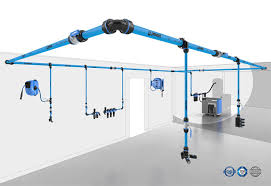
Air piping systems in an industrial factory (Source Internet)
2. Considerations for Safety in Compressed Air Piping
When planning a compressed air piping arrangement, efficiency is crucial, but so is the security of personnel and property. While using compressed air is usually safe, the following should be noted:
2.1 Examine the compressed air piping’s pressure ratings
Make sure that all parts of the compressed air system, such as the hoses, fittings, and compressed air pipe material, are rated for the air compressor’s maximum pressure when designing the system. Furthermore, if the system plan calls for a storage tank, be sure it has pressure relief valves that will immediately release air if pressures rise to unsafe levels.
2.2 Avoid using PVC for the piping of compressed air
There’s a reason PVC isn’t an OSHA-approved material for compressed air pipes. It may eventually grow brittle and crack when exposed to the high pressures and flows seen in compressed air systems, posing a risk to public health and safety. Instead, when selecting industrial plumbing solutions for a compressed air system, go for corrosion-resistant metals or OSHA-approved plastics.
2.3 Use compressed air pipes with caution and safety measures
When handling compressed air pipes, some standard safety measures need to be taken. Regular inspections of air lines are necessary to look for wear, brittleness, and other flaws that might cause pipes to rupture and debris to fly. To maintain safety and avoid dangerous situations, compressed air pipes should also be properly labeled and tagged with the maximum operating pressures.
It is also necessary to take into account provisions for thermal expansion and contraction, as well as vibration isolation.
Your compressed air system will be effective and safe if you take these suggestions into account while choosing compressed air pipes and creating a piping plan. The facility’s and the compressed air system’s performance will both be improved by a well-planned compressed air pipe arrangement.
Other reference robot accessories:
- Turntable
- Gripper
- Conveyor
- Spindle
- Electric devices
- Dress pack, robot cables
- Pneumatic devices
- Tool changer
📞 If you are looking for solutions for robotic applications in machine work, please get in touch with ROBOTNEXT, a unit specializing in the design, construction, and integration of industrial robot arms such as ABB, FANUC, YASKAWA in Vietnam.
Technical consulting hotline: 0909 914 837
Read more: Robotics Plastic Injection Machine Project
